


Black November Discounts best early deals in Australia at e365 Super Store

Don’t wait until November 28 – Black November has arrived early and your favourite brands and audio visual bundles. We are offering incredible deals
Call us on 1800 111 387
Don’t wait until November 28 – Black November has arrived early and your favourite brands and audio visual bundles. We are offering incredible deals
Call us on 1800 111 387

Communication – Solutions – Integration
Offices in Gold Coast | Sydney | Brisbane| Melbourne | Canberra | Adelaide| Perth
Click below for the latest offers and discounts
View our latest e365 Superstore newsletter


Huge discounts plus trade in offers, customer specials, & Buy one with extra discount for two specials
Most brands in Australia Videoconferencing, Audio Visual, Headsets, Phones, LED, Touch boards from Logitech , Poly, Yealink, Jabra, Samsung, Benq, Lenovo, HP, Microsoft, Google, NEC, Dell etc
Black Friday coming to e365 Distribution tomorrow !
Huge discounts plus trade in offers, customer specials,& buy one with extra discount for two specials
Most brands in Australia Videoconferencing, Audio Visual, Headsets, Phones, LED, Touch boards from Logitech , Poly, Yealink, Jabra, Samsung, Benq, Lenovo, HP, Microsoft, Google, NEC, Dell etc

1) Being on the phone gives you a sort of anonymity that can lead to distraction. From checking your email to removing all the gum wrappers from the bottom of your purse, a distracted interview on either side of the table is not beneficial. When you can make eye contact with someone, it’s much easier to capture and keep their attention to show them how qualified you are for the position.
2) Smiling! People don’t want to work with a jerk. So while you may have the best strategy proposition and three years more experience than other applicants, it can be very challenging to convey happiness over the phone without an excessive use of inflection, which in turn makes you sound like a Care Bear. Facial expressions allow you to express interest and understanding of the material being presented in a genuine way that doesn’t come across as overkill.

3) Confidence is key. So maybe you exaggerated a little on the resume that landed you the interview, but you know you’re capable and you can let this interviewer know with your impressive posture. Good posture conveys confidence, so when you’re sitting up straight during that video call, it’s that much easier to show your future employer how poised and proficient you are.
4) You control your environment! No awkward waiting rooms, no fluorescent conference room lighting—with video conferencing, candidates can meet face to face with hiring managers for the first time in a comfort zone. Plus, you can emphasize key traits of your personality that may otherwise go unnoticed. For instance, want to showcase your organizational skills? Set your video call up so your color-coded bookshelf is your backdrop. Did a quick Google search and discovered that you and your possible boss-to-be share a mutual hobby? Prop that guitar up behind you. I’m not saying that you should hang up pennants and stage the background of the call with memorabilia of his or her favourite sports team, but subtle staging can’t hurt!
Video interviews can dramatically enhance the job search from both sides of the table. With a video conferencing expert to learn more about embracing the nonverbal communication. You’ll be more engaging, enlightening and personal than you would be by phone—plus, it gives you another reason to bust out that blazer you got just for interviews. Happy job hunting!
Hate email?
If you’re in the corporate world, chances are you have an affliction like I do. Five hundred emails, 24 hours a day, two means — portable devices and your desktop — to receive them. Email has effectively beaten the telephone as a preferred way to communicate. And if you think I’m exaggerating, consider this: Intel recently noted that in exactly one minute’s time, more than 204 million emails are sent. That means more than 12 billion emails land at their destination within an hour!
Email may currently be our number one means of communication, but it is flawed. The world of email has become impersonal and sometimes even hostile. How many of us have received the dreaded “all caps” emails where you can feel the sender screaming through your screen? Often people seem too comfortable saying things in an email that they would likely never say in person or via live video.

And, while email ensures that we are in constant contact with colleagues and clients, for just some of the reasons I’ve just stated, it doesn’t necessarily mean it is better.
We’re a mobile business force — one that enjoys the comforts of a work-anywhere lifestyle, whether from the train, the back porch, you name it. And our consumer technology like virtual meetings, video conferencing and other telecommuting technology allows us to do this. We also rely heavily on social media platforms — ones with video chats, picture exchanges, and 140 characters that tell the whole story. So while just eight percent of the workforce is using these tools currently, this is the future of collaboration.
We see it every day in the way our future workforce — teenagers — keep in touch. It isn’t through email or voicemail, its Snapchat, Instagram and Whatsapp. The younger generation uses video daily in their communications, suggesting that today’s CIO needs to be thinking about opening up the corporate intranet for such video collaboration that is device and technology agnostic. Not only is it the future, it’s good for business and promotes global teamwork.
As video collaboration becomes more mainstream how global companies connect offices will impact mobility in a whole different way. our government is expected to reduce its travel costs by 50 percent across agencies. Why shouldn’t video conferencing tools encourage enterprises across industries to follow suit? And, while some are currently connecting on devices tethered to their desks, the world is becoming more mobile. Major Telephony companies see the mobile market at 6.4 billion subscribers and 50 percent of those are smart phones. With those numbers only expected to grow, more devices will enter the market with video capability — leaving video as the major contribution to mobile data traffic by 2022.
With most consumers buying mobile devices for their bigger screens and HD video capability how can CIOs replicate quality consumer experiences and ensure employees have what they need to be successful?
They’ve tried. Believe me. But one of the biggest obstacles to integrating an employee’s workflow — and making it more of the consumer experience they desire – is the use of proprietary solutions.
For the last 20 years, we’ve seen different communication channels – everything from telephony and instant messages to the email and voicemail we get today. We’ve made improvements, but we often bind ourselves because of separate platforms that cannot co-exist. Proprietary technology is costly, often not scalable and thus, IT departments cannot make it customized for their needs.
My suggestion? Let’s open it up! Cloud Videoconferencing — offers CIOs and employees an option that appears to be traditional video conferencing without being tethered to a desk or platform.

Phone calls are a thing of the past. And I would wager email is on its heels. We’re on video now. We’re on social media now. It’s a multimedia, multiplatform, multi-device world.
Today is already tomorrow; video and social media use — most prominent already in the consumer industry- – will become as natural as picking up the phone or sending an email thanks to increased use of Cloud Videoconferencing. And that’s good news. Now if you’ll excuse me, I need to respond to the 147 emails I’ve received while writing this…


Integrating video conferencing into your organization is quickly becoming essential. However, a top quality video conferencing system can be expensive. Therefore, in preparation for deciding on a provider, and choosing a plan for your company, it is well advised that you define your video conferencing requirements well before you begin to draft any contracts with vendors.
The following list should help you narrow down which types of video conferencing systems and equipment you should consider adopting when moving forward with your purchase. Make sure you consult both your management and IT departments in order to cover all bases.
There are three broad areas you should take a look at with regards to your video solutions.
The first is business requirements – the direct business goals that video conferencing should be looking to facilitate.
Next, there are functional requirements; specific details such as number or users and/or overall functionality that feed back into the business goals.
The final requirements to consider are technical. This may include any limitations you have in regards to space, systems, and bandwidth. Take advantage of the deep knowledge your IT team has in these areas before moving forward. Then ask yourself the following:
What is your organization looking to achieve with video conferencing solutions?
This is first and foremost the most important question you must ask before going forward with a video conferencing solution. The wider strategy your team outlines will be a fundamental help in determining the type of video conferencing solution you choose.
What is your budget for video conferencing solutions?
Your budget should be determined by assessing how valuable the solution will be to your operations. In addition, look at where the solution will reduce costs and improve productivity i.e. travel costs, scaling knowledge, connecting remote workers etc.
How many users does your video conferencing system expect to support?
Knowing how many users your organization will have can help you with issues such as bandwidth and pricing plans. However, knowing how much you are likely to grow in the future is just as important.
Where will your users be located?
Will your users be based in the main office or will they be remote? Remember to look to align your bring-your-own-device (BYOD) strategy with the solution to make it simpler for remote workers. Also, look at how many meeting rooms you wish to convert into video conferencing suites and, of course, don’t forget to look at all of your office and subsidiary locations.
Do you have in-house IT support or will you need to outsource?
Most vendors should be able to offer you IT support, though this will be at an extra charge. If you are fortunate enough to have onsite IT staff members, they must familiarize themselves with the solution.
Cloud or on premise video conferencing?
It’s not just applications and storage that are offered from the cloud, it is now possible to dispense with expensive video network infrastructure and have video conferencing and calling delivered as a service. This option is by far the most scalable and affordable. In very few cases, organizations prefer to have on premise infrastructure deployed behind firewalls. Therefore, engage with your IT to understand the pros and cons of both environments.
When you are going to implement a video system, follow these questions and assess your business goals to find a video conferencing solution that best suits your company.
At eVideo, we have a complete range of cloud video conferencing services and a portfolio of hardware for meeting rooms systems and software for desktop and mobile devices.
To find out more visit us at www.evideo.com.au or 1800 11 387
Sydney | Melbourne | Gold Coast | Brisbane| Canberra | Adelaide| Perth

If you haven’t been seeing the productivity you want out of your employees and your business as a whole, consider that the layout and design of your office space might be to blame. In recent years, many companies have started trying to innovate their office designs to pursue the look and feel of a modern office.
In many cases, this idea of a ‘modern office’ results in an open concept design where most employees work side by side or across from one another, clustered together in one big main room. Maybe there are a few standalone offices for senior members of the staff, or a few conference rooms for meetings, job interviews and the like. For the most part, though, the office is designed as an open floor plan.
The Problems with the Modern Office Layout
There are two core problems with this kind of office design, and you can solve both of them (at least partially) by investing in huddle room equipment for your business.
The first issue is that open workspaces, while they can drive collaboration and promote a teamwork mentality, can also create loud, distracting environments where very little actual ‘work’ gets done. There is too much chaos and not enough direction.
The second issue, meanwhile, is that the office’s open concept design means that there aren’t many other rooms for team meetings or collaboration sessions. There are a couple of larger conference rooms or boardrooms, but those are intended for more important meetings—not for gatherings of smaller teams or segmented departments.

The Benefits of Using Huddle Room Equipment
Investing in huddle room products is an effective way of reversing these negative impacts of an open concept office. Huddle rooms are smaller rooms in an office space that act as less formal conference rooms. They are maybe the size of a traditional office but come equipped with key electronics and software to allow for video conferencing, Power Point presentations, idea brainstorming and more. Best of all, the size of these rooms makes them perfect for smaller group meetings.
Having huddle room equipment and software in your office helps restore the sense of collaboration often lost amidst the madness of an open floor plan office. When your individual teams can regularly go into smaller rooms to have meetings or conversations, it removes some of the noise and chaos from the central work area. It also keeps the conference rooms and boardrooms open, available for larger gatherings.
Because huddle rooms are smaller than standard conference rooms, they cost less to outfit with key technology and software products. As a result, turning three or four smaller rooms or offices throughout your workspace into huddle rooms might be more affordable than you realise.
At eVideo Communications, we specialise in huddle room equipment and huddle room software in Australia. We can help you design and implement a huddle room strategy in your office. We predict you will start noticing the benefits right away.
To start collaborating with the eVideo team, call us today on 1800 111 387
Face-to-face interaction is critical in business communications but teams are becoming increasingly dispersed. The Video Conferencing systems on the market now are designed with smaller huddle rooms in mind

Our Team are
Our Video/Audio/IP telephony/Unified Communications solutions include:
Please let me know if you would like one of our team to discuss with you and provide the latest Communication solutions you and your organisation.
Video Conferencing and high-impact audio-visual technology is the Answer.
Today’s organizations thrive in a creative, agile and responsive working environment, where people want to engage with each other in real time – wherever they are.
Our forward thinking customers require not only specific technology, but innovation, transformation and a cultural shift towards a new way of delivering, and interacting with, information.
Implementing this type of environment can prove to be challenging due to the complexity and financial requirements of a flexible Workspace.

Business Benefit
Working environments are no longer standalone rooms with simple display screens or a flipchart. They are areas where we collaborate to create an environment where people can deliver more value to the business.
Business benefits include tangible cost savings, savings in time and office space, along with increased engagement. Video Conferencing and VCaaS (Cloud) reduces complexity of multi-manufacturer video equipment and make booking a VC as easy as a meeting, driving utilization.
Today we demand interaction and collaboration tools that engage with our customers, staff, partners etc. that provides a multi-layered experience and brand awareness.
Boardroom Management, potentially linked to room integration, automates the environment for whatever type of meeting is taking place.
Tangible Savings
We help you transform your business through the implementation of innovative audio-visual and video solutions with the ability to achieve tangible cost savings or drive customer engagement.

Virtual teams enable collaborative working, increasing the efficiency of your business and reducing the time to market.
More and more businesses are using digital signage as part of their communications and information strategy. Deployed in prominent areas such as receptions, staff restaurants, office spaces, digital signage enables engaging, dynamic and tailored content.
Video Walls and large format screens are becoming common, centrally controlled and distributed across a geographically dispersed estate.
Our Capability
Our team works closely with customers to design and implement a variety of technology solutions, including:
We are leading the way in providing a focus on design, implementation and management of Video Conferencing and high-impact audio-visual technology throughout Australia and Globally enabling our customers to be ahead of their competitors.

Adjust your camera appropriately, try to fill the screen as much as possible with people rather than with the table, chairs, walls or the floor
Place the microphone in the centre of the group, preferably on a soft surface, eg mouse mat or thick book; this will help absorb some surface noise.
Avoid tapping on the microphone and rustling papers near the microphone – this noise will be very loud at the remote site(s). (This also applies for tapping pens on desks, rattling cups and saucers and chairs bumping into table).
Avoid covering the microphone with documents, laptop covers etc – this will mute the sound and remote site(s) will not hear speaker.
Mute the microphone before moving it so that the remote site(s) doesn’t hear you moving it.
Speak in your normal voice without shouting and use natural gestures.
There is no such thing as a private conversation during videoconferencing – the microphone is very sensitive and will pick up any whispering so avoid any side conversation and ensure that only one person speaks at any one time.
Press mute button if you require privacy.
If more than three people in meeting, nominate a lead person to manage the videoconference. This lead person should control the camera, microphone and ensure smooth running of the videoconference
Once connection has been made lead person should Introduce themselves and ask remote site(s) if they can see and hear you.
Confirm that you can hear and see remote site(s).
On commencement of videoconferencing meeting all participants should be asked to introduce themselves – if participants are unknown to each other, then it is helpful to raise your hand during your introduction so that remote site can recognize who is speaking.
Sometimes there may be a slight delay between site(s), consider pausing briefly for others to answer you or to make comments
As with any meeting, try to limit side conversations and ensure that only one person speaks at any one time
During multipoint calls, lead person should ask sites to select mute when not speaking.
During multipoint calls, lead person should ensure that all sites are given the opportunity to participate or ask questions before moving on to each agenda item. This will ensure involvement of all sites.
Arrive promptly for videoconference meetings. Doors opening and closing and chairs being moved once meeting has started is distracting.
If you have to leave the meeting, ask the lead person to announce that you are leaving.
If point to point call, agree beforehand who is making the call and likewise at end of meeting agree who will be hanging up the call.
Video conferencing has come of age and is used in every industry. Recent developments in mobile devices and wireless networks have propelled further interest in being able to video information anytime, from anywhere. Generic applications of video conferencing are too numerous to mention. Any department of any organization where meetings take place—finance, engineering, human resources, manufacturing, marketing, product development, sales, training—is an appropriate place to use video conferencing to:
• Connect dispersed staff without travel
• Bring in remote experts for consultation or training
• Interview job candidates or witnesses
• Make a presentation to a vendor or customer
• View data and presentations on an on-demand or real-time basis
• Receive information at any time or place

The use of video conferencing has the potential to increase productivity and efficiency by reducing unproductive travel time, preventing meeting delays, creating shorter and more structured meetings and allowing for greater reach of a message. Video conferencing also allows for an increased number of participants. It is often difficult to get information to everyone at the same time, but with video conferencing, all individuals who need data can get the information when it is easiest for them.
The initial perceived and quantifiable benefit of video conferencing was reduction in travel costs. Initially, many organizations paid for the deployment of video conferencing with the reduction in travel budgets. While travel savings have been a recognizable benefit of video conferencing, there are many more qualitative benefits. Three
other major benefits of video conferencing are increased productivity and efficiency, improved management communications and enhanced business opportunities.
• Reduced travel risk
• Reduced unproductive travel time
• Prevented meeting delays
• Shorter meetings
• Structured meetings
• Larger participation
• Optimize attendance
• Immediate information exchange
• Faster response
• Access to experts
• Time-share scarce talent
• Quicker decisions

• More interface at all levels
• Increased flexibility
• Customer service
• Competitive advantage
The top four applications in which video conferencing is used are:
• Management meetings
• Sales and marketing meetings
• Engineering, manufacturing, or production
• Training
This does not preclude other groups from using the technology (i.e., the HR department, the legal department, finance, etc.), but studies conducted by Telemanagement Resources International Inc. (TRI) have shown that the primary reasons that firms install video conferencing relate to the top four applications noted above.
Video conferencing has also been used for a variety of other applications, including product demonstrations to new customers, “town hall” type meetings and HR training. Given the longevity of video conferencing usage, all industries have developed useful applications for video conferencing. It is no longer a matter of if you will use video conferencing; it is only a matter of when.
Video conferencing provides tangible benefits to any organization. Devices that can handle video now range from handheld devices (i.e., phones and tablets) to high-end conference rooms. The technology is easier to use, cost is no longer an issue and connectivity happens almost anywhere. Video conferencing improves the way we work and provides us more time to spend with our family and friends.
e365 Distribution has the latest BYOD Collaboration solutions for your Home Office, Huddle room and meeting rooms
Special pricing is limited till 31st October
e365 provide a Installation, Support and help desk.
e365 has the most brands in Australia and most are in stock ready for delivery Australia-Wide
Black Friday discounts have started early at e365 Distribution online Collaboration web site www.e365.com.au
If you are looking for some big discounts for
e365 has the most brands in Australia and most are in stock ready for delivery Australia-Wide
(Black Friday-Special pricing ends close of business 29/11/2019)
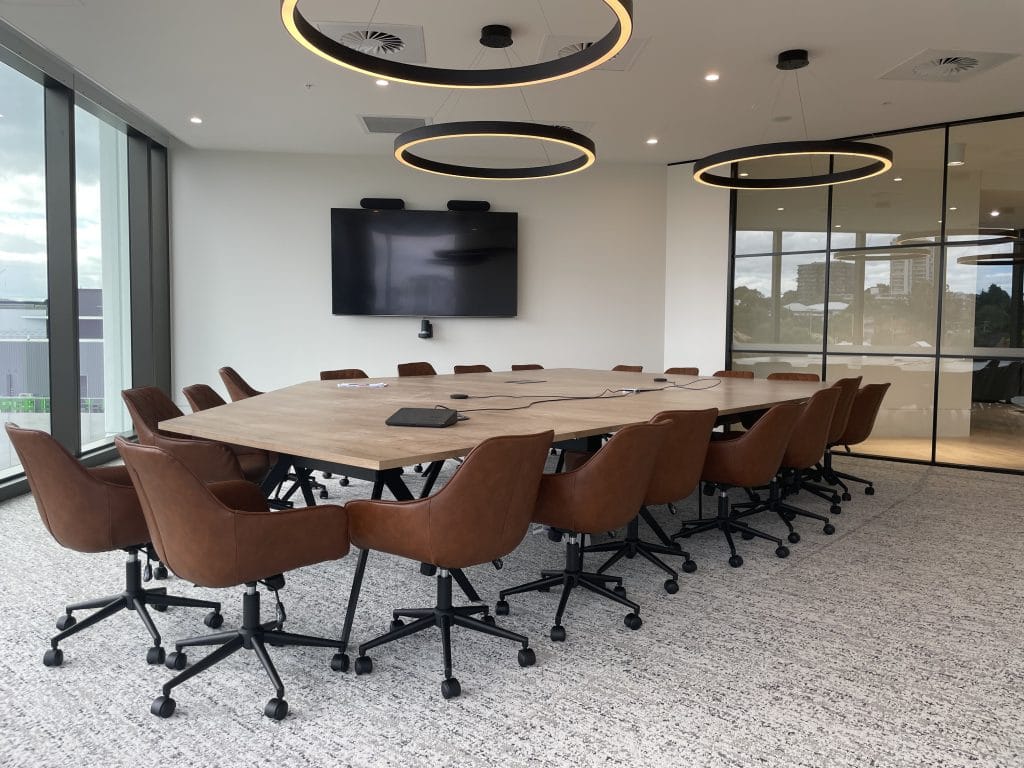
eVideo connects the latest Cisco Room kit systems for Koppen Constructions. Their staff can now have visual and audio collaboration between North Queensland and Central Queensland offices as well customers.