


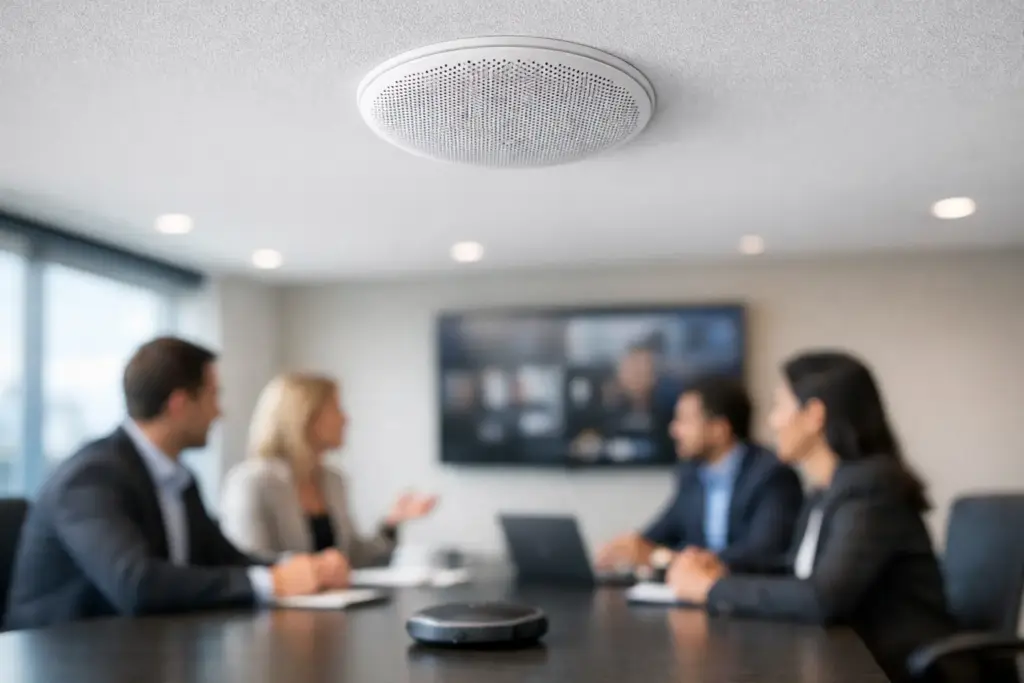
A meeting room can look perfectly equipped on paper and still fail the moment someone at the far end says, “Sorry, can you repeat that?” In most cases, the issue is not the camera or the display. It is the pickup. Choosing the right ceiling microphone for meeting room use is often what separates a room that feels professional from one that drains time out of every call.
Ceiling microphones have moved from niche AV products to a serious standard for modern conferencing. That shift makes sense. Organizations want cleaner tables, fewer exposed cables, better room coverage, and audio that works for both in-room participants and remote attendees. But not every ceiling mic is right for every space, and this is where buyers often get stuck.
Why a ceiling microphone for meeting room projects makes sense
The biggest advantage is coverage without clutter. A ceiling-mounted solution removes the need to place tabletop mics where they compete with laptops, notepads, and room booking habits. In a shared or executive space, that matters. A clean table is easier to use, easier to maintain, and presents better on camera.
There is also a performance benefit when the system is designed properly. Many ceiling microphones use beamforming or multi-element arrays to focus on voices across the room rather than relying on a single pickup point. That helps in medium and large rooms where participants do not stay fixed in one seat.
Still, ceiling microphones are not automatic upgrades in every scenario. A small huddle room with two or three people may perform perfectly well with an all-in-one video bar. In those spaces, adding a separate ceiling mic can increase cost and complexity without a clear gain. The right decision depends on room size, ceiling height, table layout, acoustic treatment, and the conferencing platform in use.
What actually matters when choosing a ceiling microphone
Audio coverage comes first. Buyers should ask a simple question before looking at brand names or specifications: how many people need to be heard clearly, and from where? A compact boardroom with a fixed table has very different pickup requirements than a flexible training space where participants move around.
Beamforming quality is the next filter. Not all beamforming is equal. Some microphones track talkers effectively and maintain natural voice pickup. Others sound thin, distant, or inconsistent when people turn their heads or speak from the edge of coverage. Manufacturer claims can be optimistic, so it helps to assess real deployment conditions rather than brochure language alone.
DSP integration matters more than many first-time buyers expect. Echo cancellation, noise reduction, automatic gain control, and mixing all affect the final result. A strong ceiling microphone paired with weak DSP can still produce poor calls. In many commercial rooms, the microphone should be considered part of a wider audio chain that includes speakers, processing, and platform-certified hardware.
Then there is compatibility. If the room is standardized around Microsoft Teams Rooms or Zoom Rooms, the ceiling mic should fit cleanly into that environment. That includes USB, Dante, or networked audio workflows, depending on the room design. For enterprise buyers outfitting multiple spaces, consistency across platforms and room types can save significant support time later.
Ceiling microphone types and where they fit
Flush-mount and pendant designs are the two most common categories. Flush-mount microphones sit more discreetly in finished ceilings and are often preferred in polished boardrooms or architecturally sensitive spaces. Pendant microphones hang lower and can be useful where ceilings are high or pickup needs to be positioned closer to the talkers.
There are also array microphones designed to work with intelligent coverage zones. These are often the right choice for larger meeting rooms, divisible rooms, or training environments where standard pickup patterns may struggle. They usually cost more, but they can reduce the need for multiple tabletop microphones and support a more scalable room design.
For many buyers, the real choice is not just microphone style. It is whether to use a single advanced array, multiple ceiling units, or a hybrid system that combines ceiling pickup with supplemental microphones. The answer depends on how predictable the room usage is. Fixed board meetings are easier to design for than flexible collaboration spaces with shifting furniture.
The room itself will make or break performance
A ceiling microphone does not operate in isolation. Hard glass walls, exposed concrete, open ceilings, and reflective tables all influence speech intelligibility. If a room is highly reverberant, even premium hardware can sound underwhelming.
That does not mean every room needs a full acoustic retrofit. But buyers should at least factor in practical mitigation such as carpet, soft finishes, acoustic panels, and speaker placement. In many installations, a better result comes from balancing microphone choice with room treatment rather than simply buying the most expensive mic in the catalog.
Ceiling height is another practical issue. A microphone specified for a standard office ceiling may not perform the same way in a space with extra height or unusual geometry. This is one reason specification-driven purchasing can go wrong. The data sheet may look right, while the installed performance says otherwise.
Integration is where commercial value shows up
For business buyers, product cost is only part of the equation. The real question is total room outcome. A ceiling microphone that needs additional DSP, custom programming, and specialized installation may still be the right choice for a flagship boardroom. But for broad room rollouts, a more standardized solution can offer better long-term value.
This is especially relevant for organizations deploying multiple rooms across offices, campuses, or client-facing spaces. Procurement teams usually want fewer compatibility surprises, simpler support, and predictable quoting. IT teams want devices that can be managed, updated, and replaced without rebuilding the room each time.
That is where specialist supply matters. A commercial technology partner can help match the microphone to the broader room stack, including speakers, conferencing compute, control interfaces, cabling, and platform certification. That reduces the risk of buying premium components that do not play well together. For organizations purchasing at scale, e365 SuperStore supports this kind of solution-led approach with access to major brands, integration guidance, and deployment support.
Common buying mistakes to avoid
One of the most common mistakes is underestimating speaker placement. If room speakers are poorly positioned relative to the microphone pickup zone, echo control becomes harder and call quality drops. Another is assuming one microphone can cover every seat because the room dimensions appear modest. Coverage on paper and coverage in practice are not always the same.
Buyers also run into trouble when they prioritize aesthetics over performance. A hidden microphone can look great, but if it is mounted in a compromised location or too far from talkers, the room pays for that decision every day. Good design should support both appearance and intelligibility.
There is also a tendency to treat all meeting rooms the same. A boardroom, a training room, and a hybrid classroom may all need ceiling microphones, but they should not be specified identically. User behavior changes the design. So does the expectation of recording quality, voice lift, or presenter tracking.
How to tell if a ceiling microphone is the right fit
If your room needs clear table-free pickup, supports more than a few participants, or serves executive, client-facing, or high-usage meetings, a ceiling microphone is worth serious consideration. It is especially effective where organizations want a premium finish and a more permanent conferencing setup.
If the space is small, lightly used, or built around a compact video bar with good onboard microphones, the return may be lower. In those cases, keeping the system simpler can be the smarter commercial move. The goal is not to install more gear. The goal is to remove friction from every meeting.
The strongest meeting room designs usually start with user behavior, then move to room acoustics, then to hardware. That order helps buyers avoid overbuying in some spaces and underbuilding in others.
A ceiling microphone is not a box-check purchase. It is part of the room experience. When it is specified well, people stop thinking about audio entirely, which is exactly the result a professional meeting space should deliver. If your team is planning a new room, standardizing multiple sites, or upgrading underperforming spaces, take the extra time to get the audio layer right. It is usually the part users remember most when it goes wrong, and the part they never notice when it is done properly.